Monitoring the Yen: Potential Intervention on the Horizon
In the world of currency exchange, the Yen has been a focal point of attention, particularly in its pairing with the Euro (EURJPY). As traders in Europe commenced their sessions on Tuesday, whispers of a possible intervention by the Bank of Japan began to circulate. The speculation arose as the Yen showed signs of weakness, hovering near a critical level of EURJPY 162.75.
Japan’s Finance Minister, Shunichi Suzuki, heightened these speculations with his remarks early Tuesday. Suzuki indicated that he was keeping a vigilant eye on the foreign exchange market and would not dismiss any measures to counteract erratic movements. This statement has led market participants to ponder the likelihood and timing of a potential intervention to bolster the Japanese currency.
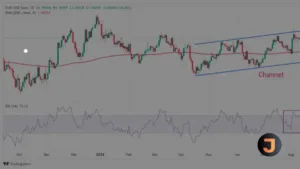
Analyzing from a technical perspective, the bearish sentiment surrounding EURJPY seems to persist. The currency pair is trading beneath both the 50- and 100-period exponential moving averages (EMA) on the four-hour chart, suggesting that sellers currently have the upper hand. The relative strength index (RSI), positioned at approximately 36.40, further corroborates this bearish outlook.
For those eyeing potential resistance levels, the first hurdle for EURJPY is projected near the 100-period EMA at 163.15. Should the pair ascend beyond this point, the subsequent target lies at the 50-period EMA at 163.32. A convincing surge past this threshold could challenge the upper limit of the Bollinger Band at 163.58, potentially propelling EURJPY towards the March 27 high of 164.41.
Conversely, support levels are also under scrutiny. The lower boundary of the Bollinger Band at 162.65 is seen as an immediate cushion for EURJPY. However, a more significant level of contention is at the 162.00 mark, which not only marks the low of March 19 but also serves as a psychological barrier. A dip below this point might trigger a descent to the March 14 low at 161.10.
As market participants continue to weigh these technical indicators against potential policy actions, all eyes remain on the Bank of Japan for any signs of decisive moves in the currency exchange landscape.