Understanding the Maze of Nonresident Income Tax Filing Laws
The intricacies of nonresident income tax filing laws can be a labyrinthine puzzle for many Americans, especially those who travel for work. A recent survey by the Tax Foundation’s TaxEDU revealed that a staggering 88 percent of people find the U.S. tax code to be complex. However, the perplexity doesn’t end there; a significant portion of this complexity is due to the lesser-known rules regarding nonresident income tax filing.
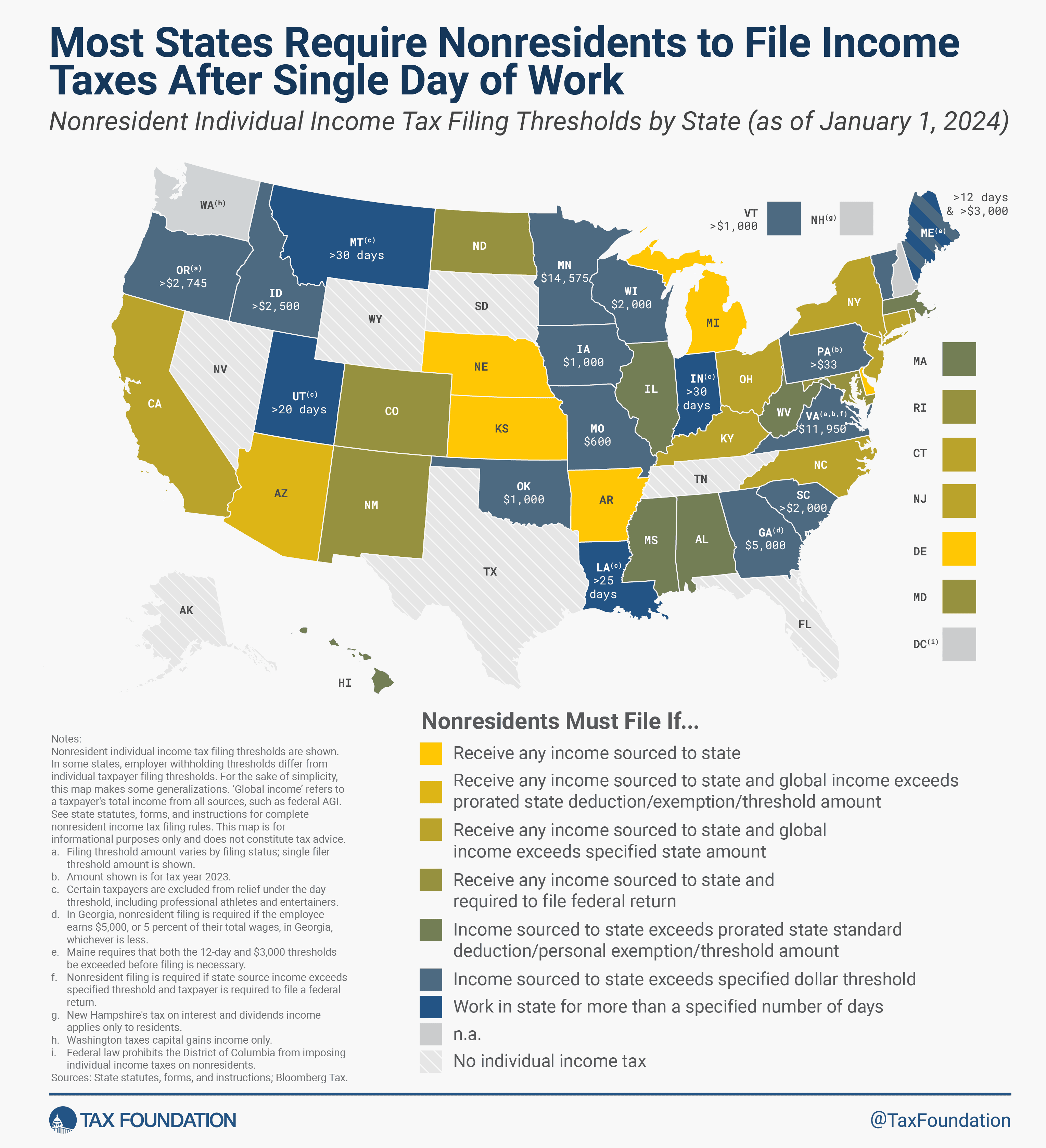
It may come as a surprise that almost half of the states in the U.S. require individuals to file nonresident income tax returns even if they’ve worked as little as one day within their borders. This requirement often goes unnoticed due to the disparity between employer withholding laws and nonresident employee filing laws, with the former typically being more lenient.
States like Arkansas and Nebraska are among the strictest, demanding nonresident filings for any amount of income earned. Conversely, states such as Georgia and Minnesota offer relief with standardized income thresholds, exempting nonresidents who earn below a certain amount. States like Indiana and Montana have established day thresholds, where nonresidents are exempt from filing unless they work over a set number of days within the state.
The complexity deepens when considering that each state has its unique definitions and calculations for taxable income, making it challenging for taxpayers to determine their filing requirements. A simpler solution proposed by some is a uniform day threshold, which could alleviate the burden of intricate calculations for sporadic work-related travel.
Moreover, states are encouraged to enter into reciprocity agreements, particularly with neighboring states, to simplify the process further. Such agreements would allow taxpayers to file only in their state of residence, even if they work across state lines.
As we advance into an era where remote work is becoming increasingly common, modernizing state thresholds and reciprocity laws for nonresident income tax filing is not just a matter of convenience but a necessity to ensure compliance and enforcement. The goal is to create a tax system that reflects the realities of today’s mobile workforce and reduces unnecessary burdens during tax season.