Tensions Rise as Turkish Cypriot Farmers Demand Action
In a significant escalation of agricultural discontent, Turkish Cypriot farmers have made their voices heard in northern Nicosia, with a robust protest against governmental decisions they say are undermining their livelihoods. The farmers, who had traveled from various parts of the north, are taking a stand against the importation of meat and what they perceive as unfair pricing practices.
The heart of the protest saw tractors and farming vehicles strategically parked in front of the ‘prime minister’s’ office, symbolizing the farmers’ determination to be heard. Trade union leaders took to the forefront, articulating the frustrations and demands of the agricultural community.
Ahmet Serdaroglu, chairman of the Free trade unions’ federation (Hur-Is), criticized the government’s approach to the farmers’ plight. “We are witnessing the biggest protest of recent times,” he declared, challenging the notion that the populace is content with current policies. Serdaroglu emphasized the rejection of imported meat and warned of future price hikes that would benefit those in power at the expense of producers.
The discourse then shifted to broader economic concerns, with Mustafa Yalinkaya, chairman of the Municipal workers’ union (Bes), accusing the government of neglecting local production and capitulating to land appropriation. “The corruption and fraud going on within the cabinet is rampant,” Yalinkaya stated, framing the issue as not only about meat but also about the fundamental right to exist and produce.
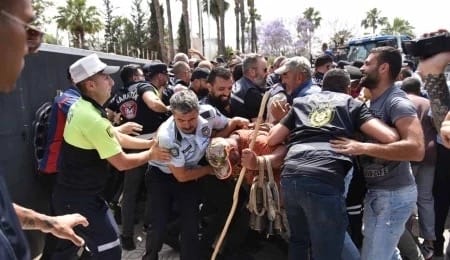
The demonstration took a turbulent turn when some protestors attempted to force entry into the ‘prime minister’s’ office, leading to a confrontation with police and subsequent arrests. In response to this altercation, farmers issued a stark warning, promising to “break down the door” if their fellow protestors were not released, underscoring the severity of their resolve.
This protest marks a critical juncture for Turkish Cypriot farmers, who are adamant about protecting their trade and ensuring their voices are not just heard but acted upon by those in power.