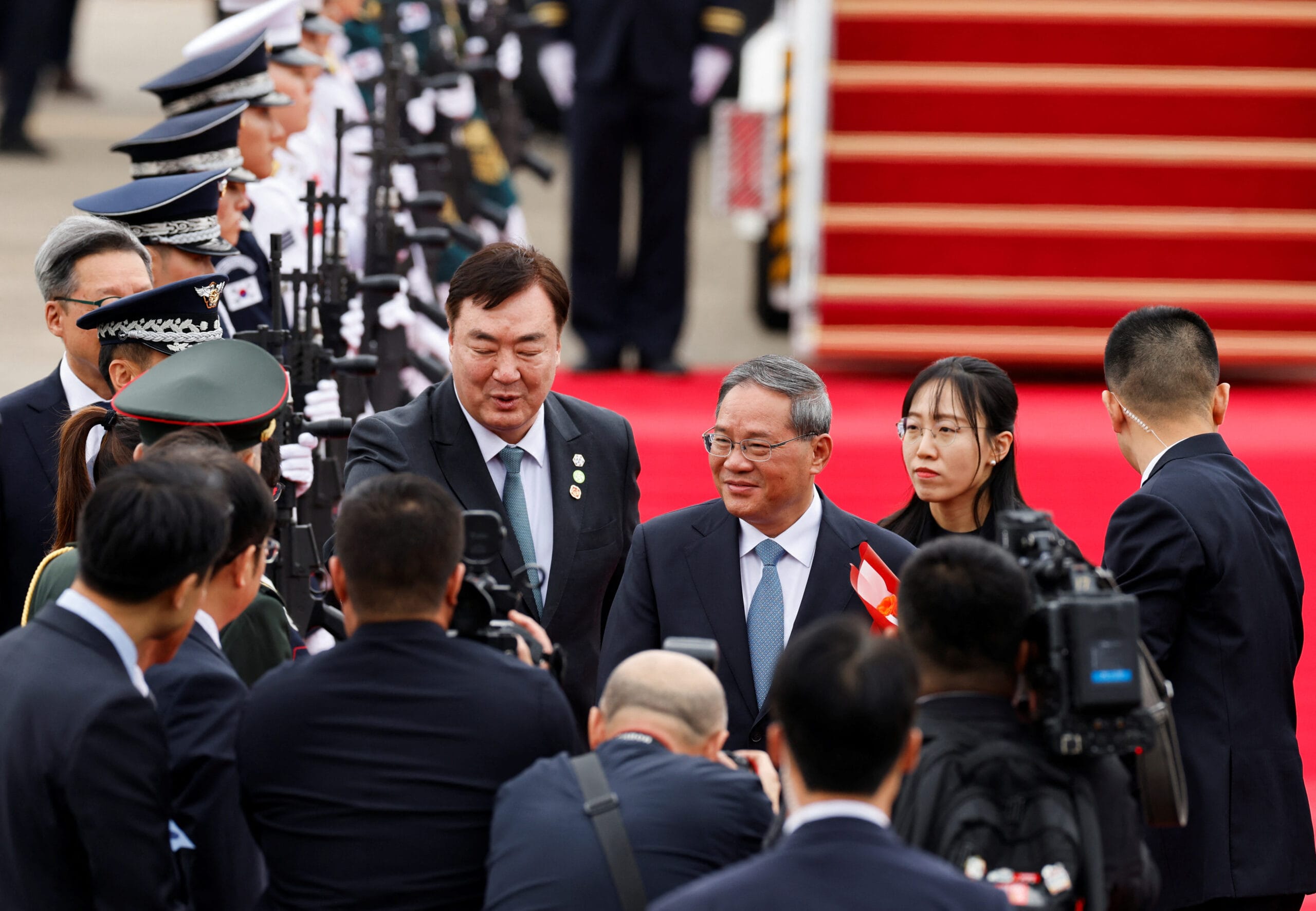
Chinese Premier Li Qiang and Japanese Prime Minister Fumio Kishida arrived in Seoul on Sunday for a trilateral summit with their South Korean counterpart, marking their first three-way talks in more than four years. The neighbours had initially agreed to hold a summit every year starting in 2008 to boost regional cooperation, but bilateral feuds and the COVID-19 pandemic disrupted the initiative. Their last trilateral summit was in late 2019.
Reviving Regional Cooperation
South Korean President Yoon Suk Yeol, Li, and Kishida are set to adopt a joint statement on six areas including the economy and trade, science and technology, people-to-people exchanges, health, and the aging population, according to Seoul officials. Yoon is scheduled to hold bilateral talks with both Li and Kishida on Sunday, ahead of their three-way gathering on Monday.
Kishida also plans to meet Li separately on Sunday, NHK reported, citing the Japanese government. According to the broadcast, he is expected to raise issues such as the Chinese ban on Japanese seafood imports and Taiwan, among other topics. Speaking with reporters before departing for Seoul, Kishida said he would seek “open and frank” discussions and hoped to foster future-oriented practical cooperation by revitalising the trilateral process.
At the talks with Li, Kishida expressed his desire to “firmly confirm the direction of the mutually beneficial relationship based on common strategic interests and constructive and stable Japan-China relations.”
Strategic Interests Amid Global Tensions
The summit comes as South Korea and Japan have been working to mend ties frayed by historical disputes while deepening a trilateral security partnership with the United States amid intensifying Sino-U.S. rivalry. China has previously warned that U.S. efforts to further elevate relations with South Korea and Japan could fan regional tension and confrontation.
Seoul and Tokyo have cautioned against any attempts to forcibly change the status quo in the Taiwan Strait. Meanwhile, Beijing criticised a decision by South Korean and Japanese lawmakers to attend Taiwanese President Lai Ching-te’s inauguration.
The summit might not bring a major breakthrough on sensitive issues but could make progress in areas of practical cooperation like people-to-people exchanges and consular matters, officials and diplomats said.