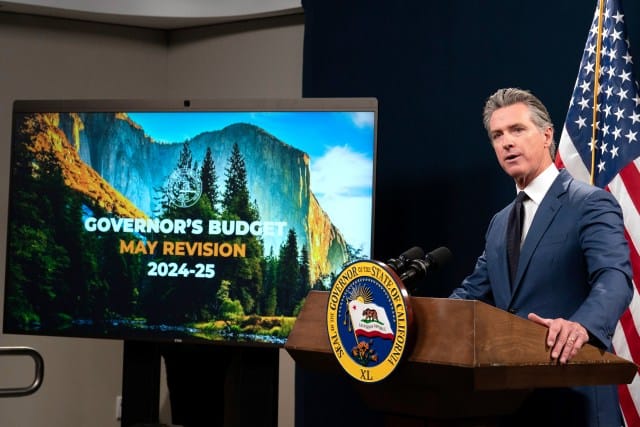
Gov. Gavin Newsom unveiled his revised 2024-25 state budget in Sacramento on May 10, 2024. When reporters pressed him about raising taxes to cover a $44.9 billion deficit, particularly the corporate tax hikes that left-leaning groups have suggested to avoid spending cuts in health, welfare, and education programs, Newsom became visibly irritated.
“When considering the 8.84% corporate tax –– which is the highest, arguably, depending on how you analyze it, in the country — no, I’m not prepared to increase taxes,” Newsom replied. “We have among the highest tax rates in the United States of America for high wage earners, we have among the highest tax rates, as I noted, for corporate taxes. … I feel strongly that we have to live within our means.”
However, the fine print of Newsom’s budget contains several indirect tax increases on businesses — mostly by reducing offsets of taxable income — that over the next few years would raise as much as $18 billion. That number comes from the California Taxpayers Association, which pulled together tax-related items from the budget and the dozens of budget trailer bills submitted to the Legislature. It approximates the $6 billion a year in income and sales taxes that Newsom’s predecessor, Jerry Brown, persuaded voters to approve in 2012 to close an earlier deficit.
Indirect Tax Increases
The biggest, in terms of financial impact, would eliminate the ability of corporations with annual revenues over $1 million to deduct net operating losses from their taxable incomes and limit business tax credits to $5 million a year. CalTax estimates it would increase corporate tax revenue by $15.9 billion over the next four years.
It would not be the first time that the state has limited or eliminated the net operating loss deduction, a history that the Legislature’s budget analyst, Gabe Petek, cited in an analysis of the maneuver. The deduction, Petek said, “allows businesses to smooth profits and losses such that businesses with similar profits over time pay similar taxes. Without this smoothing, businesses in riskier or more innovative industries — such as the technology, motion picture, and transportation sectors — could end up paying more taxes than businesses with similar but more stable profits. As such, suspending NOL deductions would lead to a less equitable tax system.”
“Should the governor’s proposal take effect, the state will have disallowed NOL deductions in nearly half of years between 2008 and 2027,” Petek continued. “At this rate, it seems reasonable to ask whether suspensions have begun to meaningfully undermine the purpose of allowing NOL deductions in the first place.”
The second largest — and perhaps most intriguing — indirect tax increase Newsom proposes is to overturn a recent decision of the state Office of Tax Appeals favoring Microsoft in a complex, years-long dispute with the Franchise Tax Board over the tax treatment of foreign earnings.
In effect, the appeals panel declared that the Franchise Tax Board erroneously applied state law on taxing multinational corporation earnings. The FTB estimates that it could cost the state $1.3 billion in refunds immediately and hundreds of millions more in future years. The administration’s trailer bill would nullify the ruling by declaring that the FTB correctly applied the law. It would be in effect retroactively and potentially allow the FTB to promulgate new regulations to enforce without going through the normal rule-making processes.
In addition to its fiscal impacts, the legislation sets a questionable precedent of retroactively changing tax laws after taxpayers have won appeals. Such ex post facto legislation undermines the integrity of the tax system.
If nothing else, Newsom’s proposals underscore again the premise that declaring who or what is taxed is an arbitrary political act, not a rational exercise.