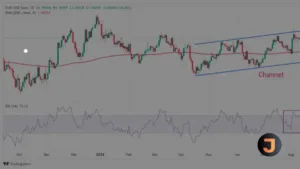
USDJPY bulls are further encouraged by a weakening Japanese Yen following data that shows real wages declining for the 25th straight month in April, as domestic inflation in Japan continues to outpace wage growth. The data will make it harder for the Bank of Japan to normalise policy, as it hopes to lift the bank’s rate from an ultra-low 0.0% – 0.1% range and support its beleaguered currency.
The dollar-yen pair bounced off the 50-day Simple Moving Average (SMA) and pumps higher as the USD continues its resurrection after the recent post-ISM Manufacturing PMI miss sell-off. The pair is trading above 156.00 on Wednesday, up 0.8% on the day.
Market Sentiment and BoJ Policy
Rumours that the BoJ is poised to reduce bond purchases at its June policy meeting benefited JPY (negative for USDJPY) on Tuesday. Such a move would put upward pressure on Japanese bond yields which are highly correlated to the JPY. However, it remains to be seen whether the rumours materialise on the day. The risk of intervention is also a constant threat to USDJPY bulls.
On Tuesday, Deputy Governor of the BoJ Ryozo Himino repeated concerns about how a weak JPY could negatively impact the economy. His comments suggested the BoJ might be preparing for another direct intervention in Forex markets to prop up JPY (negative for USDJPY). Himino also discussed how the weak Yen was impacting inflation. Although it drove up the price of imported goods, thereby generating inflation – which is what the BoJ wants – Himino said this is not the sort of inflation the BoJ wishes to encourage as it makes imported goods unaffordable for ordinary shoppers. The BoJ would prefer inflation from higher wages instead, as this would lead to more spending and a more dynamic economy.
According to analysts at Rabobank, Himino’s remarks “ratcheted up concerns that the BoJ could confront the market with a hawkish policy move at its June 14 policy meeting.” Indeed, both the safe-haven JPY and Swiss Franc (CHF) are falling on Wednesday as market morale improves. Most European equity indexes are trading higher and in the commodity sphere, oil, softs and precious metals are up, but non-precious metals and lumber are down.
USDJPY seemed unfazed by US jobs data on Wednesday, after Automatic Data Processing (ADP) released its payrolls figures for the private sector. The data showed payrolls increased by only 152,000 which was below the 173,000 forecast and the revised down 188,000 of April. US ISM Services PMIs is also out on Wednesday, whilst on Friday, the US Bureau of Labor Statistics will release non-farm payrolls (NFP) which could be a major USD mover. If the US data is weak in line with the general trend of late, it could undo the USDJPY’s recovery rally and plunge the pair back down below 155.00 again.