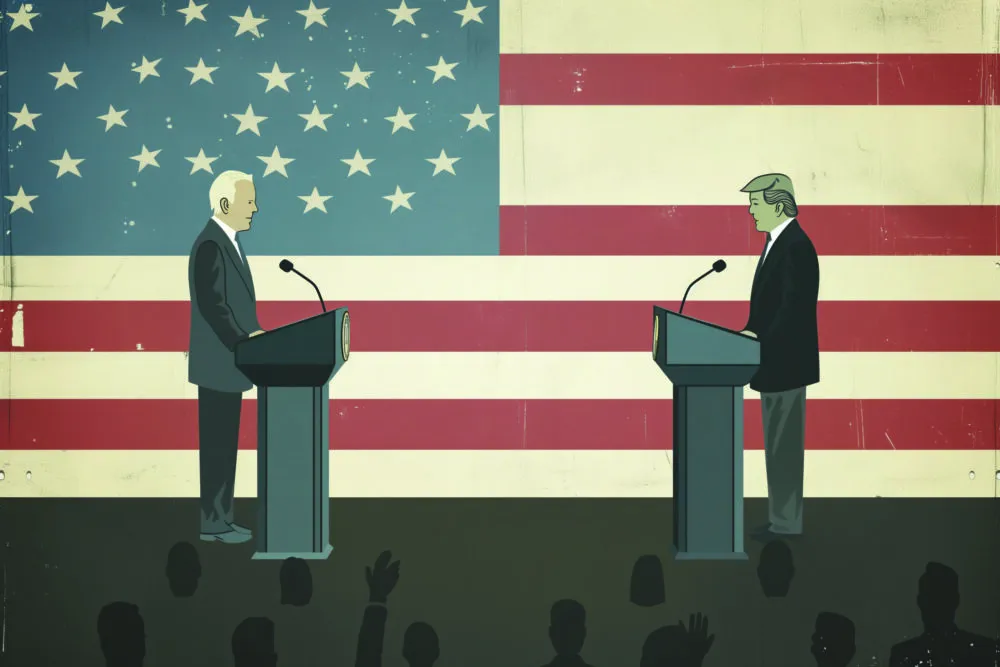
The differences in proposed tax policy between the presumptive presidential candidates, at this point, in the two main parties — President Joe Biden and former President Donald Trump — are vast, according to Garrett Watson, senior policy analyst with Tax Foundation, a nonpartisan tax policy think tank. “The differences between what (the candidates) want to do is going to create a lot of uncertainty,” Watson says.
In his State of the Union (SOTU) address in March, President Biden made it clear he’s not waging war with corporate America. Indeed, Biden did spend decades in the U.S Senate representing Delaware — the so-called “Corporate State” for its dominance in corporate law. Still, Biden made it clear he believes corporate America is not paying its fair share in taxes. “The way to make the tax code fair is to make big corporations and the very wealthy begin to pay their share,” Biden said in his SOTU.
Based on Biden’s proposed budget for fiscal year 2025 as a source for where Biden stands on taxes, several major tax increases would increase taxes significantly for businesses and high-income individuals. The Biden budget calls for raising the corporate income tax rate to 28% from the current 21% enacted under the 2017 Tax Cuts and Jobs Act (TCJA) during the Trump administration. Other budget proposals include an increase in the corporate alternative minimum tax rate (which was introduced under the 2022 Inflation Reduction Act) from 15% to 21%. Another proposed hike would raise the excise tax on certain corporate stock buybacks from 1% to 4%.
The current deduction limitation of $1 million on compensation to senior executive officers would be extended to all employees. In addition, the budget proposes to repeal some tax provisions in the oil and gas industry. By comparison, Trump, to date, has proposed keeping the 21% corporate income tax rate that was enacted under the TCJA. “There is an understanding that Trump would prioritize permanence or preserving TCJA provisions, but there isn’t much else in terms of (tax policy) detail otherwise,” Watson says. Trump has called for a universal baseline tariff on all U.S. imports and a 60% tariff on all imports from China, according to Tax Foundation. “The tariff proposals also loom as a general risk for businesses who may be exposed to them directly or via countermeasures,” Watson says.
Regulations
The Biden administration has been aggressive with rules and regulations, and some believe that could continue in a second term. A few recent examples include the signing of an executive order in October 2023 for new standards for safety and security of artificial intelligence and an executive Order in February 2024 to protect Americans’ data security. In April 2024, the Federal Trade Commission (FTC) issued a rule to ban noncompete clauses nationwide and the Environmental Protection Agency (EPA) issued rules to reduce pollution from fossil-fuel-fired power plants.
Chamber CEO Suzanne P. Clark has decried the administration’s regulatory actions as “a thin disguise for the real purpose: establishing sweeping new powers that can be weaponized whenever and against whomever these agencies chose.” According to the U.S. Chamber of Commerce, the world’s largest business organization, the Biden administration plans to act on 2,500 regulatory actions by the end of its first term. The chamber has vowed to fight back in court. It has sued over the SEC’s climate disclosure rule, the FTC’s non-compete ban, the Consumer Financial Protection Bureau’s credit card late fees rule, the Occupational Safety and Health Administration’s (OSHA’s) walkaround rule and the Federal Communications Commission’s digital discrimination rule, among others.
The Democratic National Committee says Trump is running on the “extreme” and “dangerous” agenda of the 2025 Presidential Transition Project from The Heritage Foundation, a conservative think tank. Project 2025 has released its policy guide for the next conservative U.S. president — Mandate for Leadership: The Conservative Promise. Mandate includes recommendations for reining in the EPA, the Internal Revenue Service and OSHA, to name a few. Dealing with regulation is a significant issue in the current Mandate.
One year after taking office in 2017, Trump and his administration had embraced nearly two-thirds of the policy recommendations from the 2017 Mandate for Leadership, The Heritage Foundation reported in 2018. At an April 2024 meeting with oil executives, Trump reportedly said he would reverse dozens of Biden’s environmental rules and policies — and stop new ones — if the executives joined together to raise $1 billion to send him back to The White House, according to The Washington Post.
The news stunned many political observers but fit with concerns that government power will be used to reward or punish companies. “Businesses have to be prepared — if Trump wins — for a politicized bureaucracy,” says Ann Lipton, Michael M. Fleishman Associate Professor of Business Law and Entrepreneurship at Tulane University Law School Such a move would further heighten uncertainty in the boardrooms of corporate America, she says. But regardless of who wins in 2024, boards will have to continually monitor government actions that could impact their companies.
Corporate directors might consider the writings of Edwin J. Feulner, founder and former president of The Heritage Foundation, for an indication of what the political environment could be like going forward. “In Washington, there are no permanent victories. But neither are there permanent defeats,” Feulner writes at the end of Mandate. “Rather, there are permanent battles throughout the policy arena.”