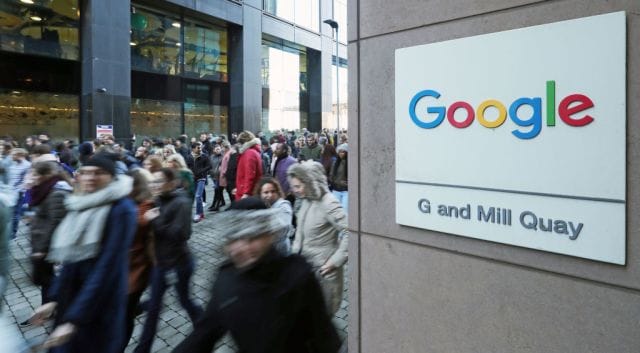
Google’s European headquarters in Dublin, Ireland. Niall Carson/PA Images via Getty Images
Ireland, despite its small land size and population, is among the wealthiest countries in the world. The island nation boasted a GDP per capita of $104,270 in 2023, according to the IMF, next only to Luxembourg and higher than the U.S., Switzerland, Singapore, and Norway. It is also one of the fastest-growing economies in the world, with its GDP growing 15.1 percent and 9.1 percent in 2023 and 2022, respectively.
Ireland’s journey from the devastation of the Great Famine, which claimed at least a million lives between 1845 and 1852, to its struggle as one of the poorest nations in Europe after part of the island gained independence from the United Kingdom in 1922 was marked by significant challenges, including mass emigration to the U.S. and neighboring countries. Before the 1840s, the Emerald Isle was home to approximately 8.2 million people, a population level yet to recover fully.
A Tax Haven for U.S. Tech Giants
In the 20th century, Irish leaders began implementing pro-business policies to jump-start its economy. The country established the world’s first trade zone outside its small international import in 1959, attracting international businesses to build manufacturing plants. Dubbed the “Shannon Free Trade Zone,” corporations were allowed to avoid taxes by building in Ireland and hiring local workers. The country also created a business environment marked by low taxes and lax regulation, which included the controversial tax loophole known as “Double Irish with a Dutch Sandwich.”
Apple (AAPL) was among the first to take advantage of the loophole, opening its first non-U.S. office in Ireland in 1980. Dozens of tech and pharmaceutical companies followed suit, fueling job creation and economic growth. From 1995 to 2005, Ireland’s annual GDP growth averaged a remarkable 9.4 percent, earning the country the nickname “Celtic Tiger.”
The Shannon Free Trade Zone ended in 2003, and the E.U. forced an end to the “Double Irish” tax loophole in 2015. Nevertheless, Ireland has established itself as a hub for U.S. companies looking to expand to European markets, so the momentum continues: in 2023, 167 U.S. companies opened offices in Ireland.
Ireland still has one of Europe’s lowest corporate tax rates, at 12.5 percent, much lower than the 21 percent corporate tax rate in the U.S., and is the only English-speaking country remaining in the E.U. after Brexit. The Irish government is seeking to raise the corporate tax rate to 15 percent for some large companies, but the appeal remains. “Google (GOOGL) and other tech firms are here for one reason, and it’s taxes,” a Google financial analyst based in Dublin told Observer anonymously.
American tech giants play an outsized role in Ireland’s economy. Some 60 percent of Ireland’s corporate tax revenue comes from just 10 U.S. companies, according to the Irish Tax and Customs department.
GDP Can Be a Misleading Measure
However, the Irish government has called GDP a poor way to measure its economy. GDP is the sum of government expenditures, consumer and private consumption, net exports, and investment. In Ireland, however, the latter two measures are highly distorted by multinational corporations operating in the country.
For example, Apple claims iPhones are exported from Ireland for accounting purposes when they are actually designed in the U.S. and primarily manufactured in Asia. Thus, iPhone sales accounted for a quarter of Irish GDP growth in 2018 but hardly brought any money into the country. The Irish Tax Institute finds that 85 percent of Ireland’s exports come from foreign-owned companies.
Investments in Ireland are also distorted: an IMF study found that two-thirds of investments made in the country are “phantom,” meaning they “pass through empty corporate shells” with no benefit to the actual economy.
To better understand its economy, the Irish government uses gross national income (GNI) and modified domestic demand (MDD), which factor out much of the distortion from international corporations. When measured by GNI and MDD, Ireland is far from being a wealthy, fast-growing nation but an economy that has grown slowly over the last decade.
Ireland’s economic story underscores the limitations of GDP in measuring a country’s true wealth. While multinational investments have propelled Ireland to the top of the GDP charts, the average Irish citizen faces a different reality.