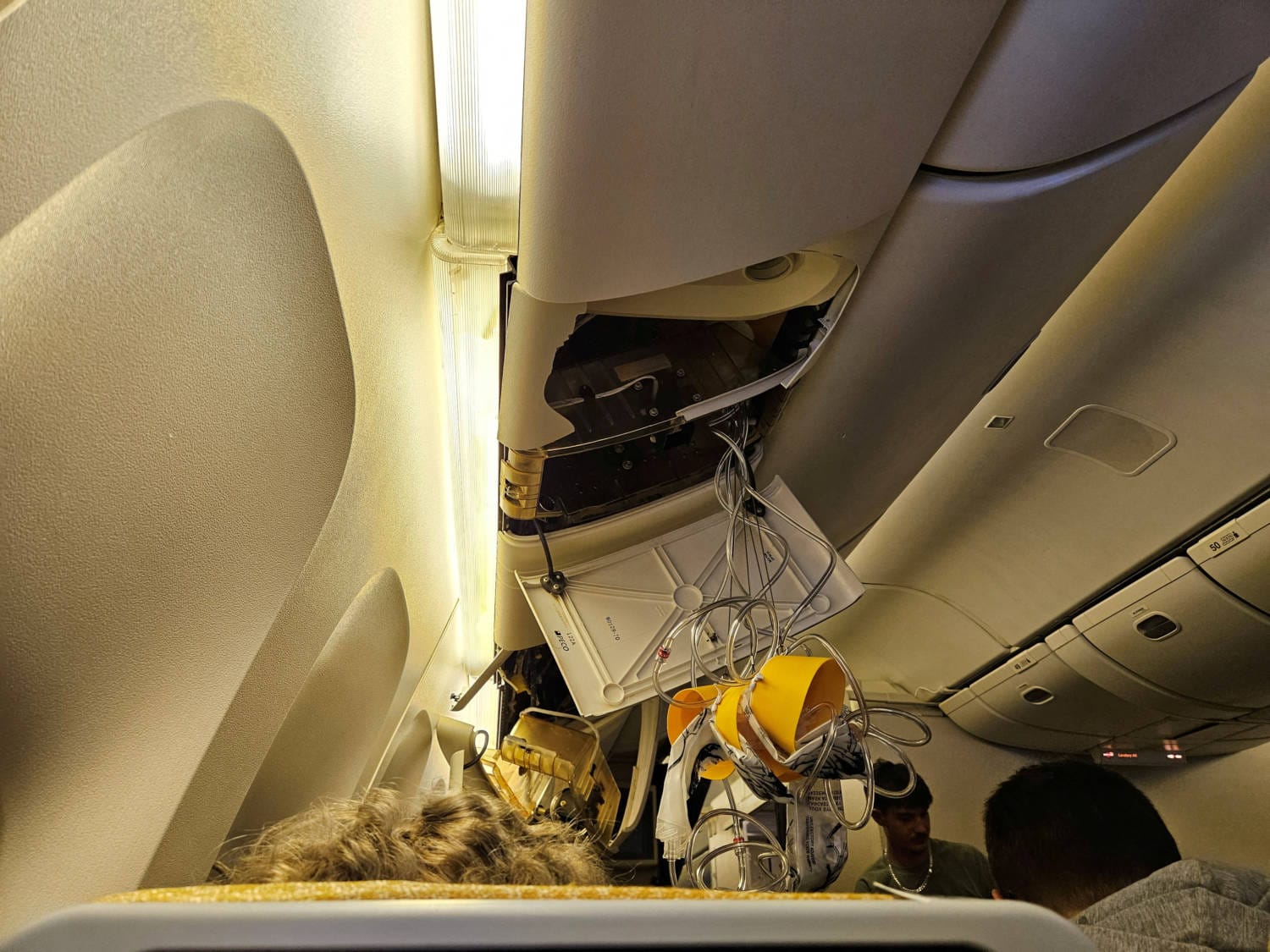
One passenger died of a suspected heart attack and 30 others were injured after a Singapore Airlines SIAL.SI flight from London to Singapore hit severe turbulence on Tuesday, forcing the Boeing 777-300ER jet to divert to Bangkok, authorities said.
What is Turbulence?
Turbulence or pockets of disturbed air can have many causes, most obviously the unstable weather patterns that trigger storms, according to an industry briefing by planemaker Airbus. The resulting water particles can be detected by weather radar.
Singapore Airlines did not immediately say what type of turbulence was involved. Tracking service FlightRadar24 said there were storms – some severe – in the area at the time.
…And Clear Air Turbulence?
Known by its abbreviation CAT, this is a sudden and severe swirl that causes violent buffeting of a plane even where there are no clouds, according to the Federal Aviation Administration.
Such invisible pockets of air can appear without warning and are hard to predict. Mark Prosser of the University of Reading said Tuesday’s event most likely involved convective or storm-related turbulence, but stressed it was too early to be certain.
An investigation has been launched and experts stress aircraft accidents typically involve a combination of factors.
How Common Is It?
Turbulence-related incidents are common, according to a 2021 study by the U.S. National Transportation Safety Board.
From 2009 through 2018, it found that turbulence accounted for more than a third of reported events and most resulted in one or more serious injuries, but no aircraft damage.
Yet fatal turbulence in air travel remains extremely rare.
“It is a very unusual and rare event. As far as I can tell it is over 25 years since a passenger was killed by commercial airliner turbulence,” said Paul Hayes, director of safety at UK-based aviation data group Cirium Ascend.
The last fatal turbulence-related accident on Cirium’s database involved a United Airlines Boeing 747 in 1997.
How Do Pilots Respond?
Crews plan ahead by studying turbulence and other weather forecasts, which have improved over the years, loading extra fuel when needed and monitoring weather radar during flight.
But sometimes violent CAT leaves little time to react.
“If it’s unexpected then it’s a bit late. You hope to get warnings from other aircraft in the area and slow down to make sure the effects are minimised,” said retired pilot Hugh Dibley, an expert on aircraft upsets at the Royal Aeronautical Society.
Which Planes Are Best for Turbulence?
In terms of their structure, all modern commercial jets are built to cope with forces many times those experienced in-flight, Hayes said.
But according to Swedish turbulence-forecasting website Turbli, the feeling experienced by passengers varies from plane to plane and seat to seat.
Long planes can feel most turbulent at the back and the ideal spot is around the centre of gravity, which is typically just ahead of the wings.
Boeing’s high-tech 787-9, with a “Gust Alleviation System” from Honeywell HON.N, ranks first for handling turbulence, according to Turbli. Next is the Airbus A340-500/600, though the four-engined model is no longer widely used due to fuel costs.
The Boeing 777 family is widely seen as having a strong safety record – excluding Malaysia Airlines MH17 which was downed by a missile over Ukraine and the mystery disappearance of MH370, both in 2014. It is equipped with traditional weather radar but does not have the newer 787’s alleviation system.
What Does It Mean for Seatbelts?
U.S. airline pilot and flight attendant unions told Reuters the incident highlights the importance of following crew instructions and wearing seatbelt whenever seated.
But they cautioned that leaving the seatbelt sign on all the time could erode its significance and that passengers could start ignoring it.
Among the most exposed to injury are crew who must tour the cabin to check seatbelts have been fastened when signs go on.
Is There Any New Technology?
NASA says it is developing an early-warning system that relies on ground-mounted infrasonic microphones to detect clear-air turbulence hundreds of miles away.
Austria-based tech startup Turbulence Solutions says it is developing technologies to eliminate up to 80% of turbulence.
But industry experts caution any new aircraft systems must be proven to work to a high level of reliability and it takes years of rigorous testing before technology can be validated. Airlines must usually agree to foot the bill for any upgrades.
Is Climate Change to Blame?
A spate of turbulence reports has triggered a debate over whether climate change may be causing more turbulence.
A report from the University of Reading last year suggested turbulence could worsen with climate change.
“Our latest future projections indicate a doubling or trebling of severe turbulence in the jet streams in the coming decades, if the climate continues to change as we expect,” said Professor Paul Williams, one of the authors.
However, he told Fox News that while there seems to be a strong correlation, more research is needed.
“It’s too early to definitively blame climate change for the recent apparent increases in turbulence. Increased media coverage, aided by in-flight video footage from passengers’ mobile phones, may well be a factor,” Williams added.
(Reuters)